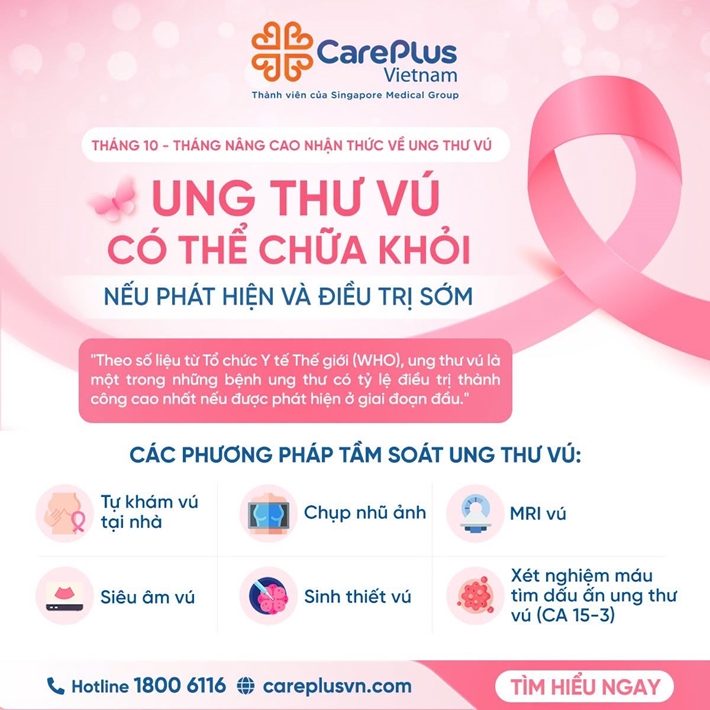
BREAST CANCER CAN BE CURED IF DETECTED AND TREATED EARLY!
10/22/2026 10:20:08 AM
Every October, Breast Cancer Awareness Month paints the world pink. This is not just a media campaign—it is a practical reminder to protect the health of more than 2.4 million women living with this disease globally.
The color pink is not only for women. The campaign welcomes everyone—including women, men, non-binary, and transgender individuals—to:
-
Accompany & Support: Stand alongside breast cancer patients (including those in metastatic stages) throughout their treatment journey.
-
Educate & Raise Awareness: Correctly understand the risks and proactively listen to your body.
-
Promote Regular Screening: Encourage mammograms starting at age 40 (or earlier depending on personal risk).
-
Take Practical Action: Raise research funds and honor diverse groups within the community.
Join Dr. Pham Nguyen Thao Ngan (Specialist I) – Department of Obstetrics and Gynecology, CarePlus International Clinics – as she comprehensively decodes Breast Cancer to help you proactively protect yourself and your loved ones!
1. What Is Breast Cancer?
Breast cancer occurs when cells in the breast tissue grow abnormally and uncontrollably. It is the second most common malignant disease in women, but anyone with breast tissue is at risk, including men.
Breast cancer survival rates are increasing significantly, and mortality rates are steadily decreasing thanks to breakthrough advances in early screening technology, which allow tumors to be detected when they are still very small.
Distinguishing Benign vs. Malignant Tumors:
-
Benign Tumors: Softer structure, round/smooth surface, move easily when touched, and usually do not invade surrounding tissue.
-
Malignant Tumors (Cancer): Firm or hard density, irregular shape, fixed (less mobile when pressed), and capable of invading and destroying healthy tissue. Most early-stage malignant tumors do not cause pain.
2. Recognizing Warning Signs of Breast Cancer
Early-stage breast cancer often progresses silently and is detected only through routine mammograms. As the disease advances, symptoms become clearer:
Common General Signs:
-
Appearance of a lump or unusually thickened tissue in the breast or armpit.
-
Flattened, indented, or inverted nipple.
-
Changes in breast skin surface: Wrinkling, dimpling, orange-peel texture, or flaking/crusting.
-
Skin color changes: The breast skin turns pink, red, purple, or darker than surrounding areas.
-
Unusual changes in size or shape of one breast.
Signs by Specific Group & Disease Type:
-
Metastatic Cancer (Advanced Stage): Bone pain, prolonged fatigue, shortness of breath, unexplained weight loss, or swollen lymph nodes in the armpit/neck.
-
In Men: A hard lump near the nipple, retracted skin/dimpling, inverted nipple, or discharge/bleeding from the nipple.
-
Inflammatory Breast Cancer (Highly Aggressive): Progresses rapidly within weeks. The breast swells, feels heavy, and the skin becomes warm to the touch, red/purplish, resembling a rash or infection.
Advice from CarePlus Doctors: If you detect any unusual change or lump, see a doctor immediately. Do not wait for your next mammogram or assume everything is fine based on a previous normal exam result.
3. Causes & Risk Factors
No single cause has been definitively proven to cause breast cancer. The disease results from a complex interaction among genetic, hormonal, and environmental factors.
Unchangeable Risk Factors:
-
Age & Gender: Risk increases as women get older.
-
Genetics & Family History: Carrying inherited gene mutations (such as BRCA1, BRCA2) or having close blood relatives (parents, siblings, children) with breast cancer.
-
Personal History: Previous history of cancer in one breast, or prior lesions such as lobular carcinoma in situ (LCIS) or atypical ductal hyperplasia.
-
Dense Breast Tissue: Less fatty tissue and more glandular/fibrous tissue increases risk and makes detection harder on mammograms.
-
Reproductive History: Early onset of menstruation (before age 12), late menopause (after age 55), giving birth to a first child late (after age 35), or never having been pregnant.
-
Radiation Exposure: Previous radiation therapy to the chest during childhood or adolescence.
Lifestyle Risk Factors:
-
Alcohol Consumption: Alcohol significantly increases disease risk (there is no safe consumption threshold).
-
Obesity and Overweight: Especially after menopause.
-
Use of Menopausal Hormone Therapy: Long-term use of combined estrogen and progesterone.
4. Proactive Prevention & Early Detection
Although 100% prevention is not possible, you can actively minimize risks and increase treatment success through these measures:
-
Minimize Alcohol: It is best to say "No" or limit consumption to less than 1 drink per day.
-
Increase Physical Activity: Exercise for at least 30 minutes a day, most days of the week.
-
Control Weight: Maintain a healthy BMI.
-
Breastfeed: The longer the duration of breastfeeding, the greater the protective effect on breast tissue.
-
Be Cautious with Hormone Therapy: Consult thoroughly with a doctor before using menopausal hormone therapy.
The "Golden Key": Listen to Your Body & Get Regular Screenings
-
Monthly Breast Self-Exam: Familiarize yourself with the normal look and feel of your breasts to easily spot any unusual changes.
-
Mammography & Advanced Screening: Most women should start regular screening from age 40 (every 1–2 years). High-risk individuals (with genetic mutations or family history) should proactively begin screening earlier under specialist guidance.
Proactively screen today – Protect your entire future! Contact CarePlus International Clinics today for precise and safe breast cancer screening consultations with our experienced medical specialists.
🔔 At CarePlus International Clinics, screening programs are tailored based on age, medical history, and risk factors of each patient, supporting women on their journey toward proactive healthcare for peace of mind and better daily health:
🔸 Program 1 – Breast Cancer Screening Service (For women from age 40) – Includes: Mammogram and consultation with an OB-GYN Doctor.
Learn more here: https://www.careplusvn.com/vi/dich-vu-tam-soat-ung-thu-vu-cho-phu-nu-tu-40-tuoi-chuong-trinh-1
🔸 Program 2 – Breast Cancer Screening Service (For women from age 40) – Includes: Mammogram, breast ultrasound, and consultation with an OB-GYN Doctor.
Learn more here: https://www.careplusvn.com/vi/dich-vu-tam-soat-ung-thu-vu-cho-phu-nu-tu-40-tuoi-chuong-trinh-2