EXPERT ADVICE: CHILD DROWNING PREVENTION
9/8/2026 3:11:21 PM
Did you know? Drowning happens far more silently than most people think. Without splashing or cries for help, a child can submerge in just a few brief seconds—even in seemingly harmless water depths of only a few centimeters. In Vietnam, drowning is the leading cause of accidental injury and death among children. The statistics show:
-
Approximately 2,000 children die from drowning in Vietnam every year, averaging about 5 children per day.
-
Vietnam's child drowning mortality rate is roughly 10 times higher than that of developed countries.
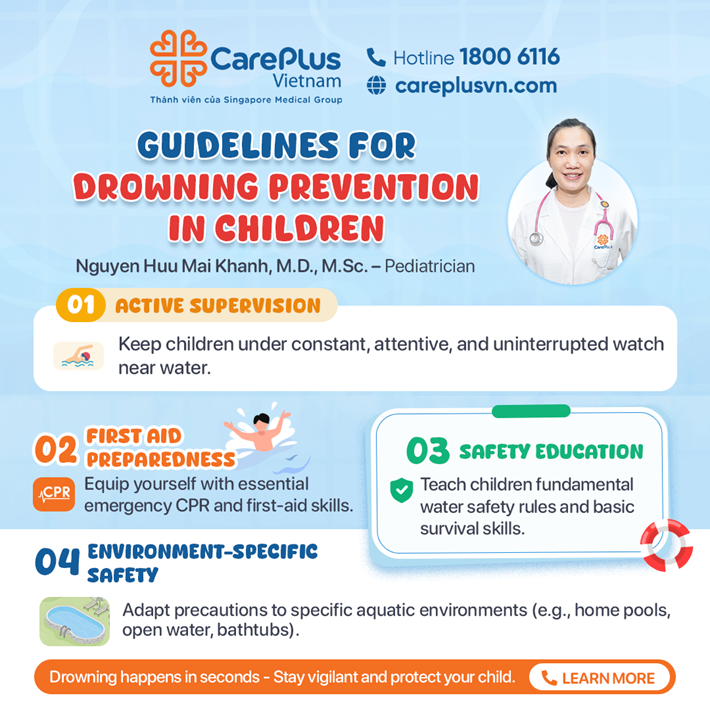
💙 In this article, Dr. Nguyen Huu Mai Khanh (MSc, Pediatric Specialist) shares essential knowledge and principles to help parents proactively prevent drowning and keep their children safe around water.
WATER SAFETY ESSENTIALS
Drowning occurs rapidly. Beyond swimming lessons, equip your child with safety skills and proactive prevention habits:
1. Maintain Active Supervision
-
Keep eyes on children whenever they are in or near water, even if they know how to swim.
-
Maintain undivided attention—avoid phone distractions and never leave children unattended.
-
Do not delegate supervision to an older sibling.
-
Use properly fitted life jackets when necessary.
2. Learn First Aid and Emergency Preparedness
-
Parents should learn pediatric CPR and first aid skills.
-
In a drowning emergency, call 115 immediately and transport the child to a medical facility without delay.
3. Teach Children Safety Rules
-
Never enter the water without adult permission.
-
Teach children to identify hazardous areas and comply with safety regulations.
-
Encourage formal swimming lessons and water safety training.
4. Practice Environment-Specific Safety
-
In the Bathroom:
-
Actively supervise children—especially under 5 years old—during baths.
-
Keep young children within arm’s reach, even when using a bath seat.
-
Drain all tubs, basins, and buckets immediately after use.
-
Never leave a child unattended in the bathroom, even for a moment.
-
At the Beach:
-
Closely supervise children both on the sand and in the water.
-
Pay attention to warning flags/signs and avoid swimming in unsafe zones.
-
At the Swimming Pool:
-
Stay alert when children are in, on, or near the pool, even with lifeguards on duty.
-
Allow swimming in deep water only when directly accompanied by an adult.
-
Prohibit running or jumping around the pool deck.
-
Near Lakes or Rivers:
-
Lakes and rivers present hidden hazards; maintain continuous supervision in these areas.
-
Verify water safety conditions before letting children enter.
-
Prohibit diving or jumping into open water, as depths can be deceiving.
-
Teach children never to swim in strong or fast-moving currents.
DOCTOR’S ADVICE
-
Never leave children unattended near any body of water.
-
Drain tubs, buckets, and portable pools immediately after use.
-
Keep bathroom and restroom doors closed when not in use.
-
Install a four-sided safety fence with a self-latching gate around residential pools.
-
Use approved, properly fitting life jackets.
-
Learn CPR and emergency first aid.
-
Educate children on water safety rules and awareness.
A moment of inattention can lead to lifelong consequences. Protect your children through active vigilance and preparation starting today!
📞 Call our toll-free hotline at 1800 6116 to book an appointment for consultations and exclusive offers.