ATOPIC DERMATITIS IN CHILDREN: PREVENTING FLARE-UPS WHEN THE WEATHER CHANGES
11/17/2026 3:52:51 PM
👩🏻⚕️ Medically reviewed by MSc. Dr. Nguyễn Đoan Quỳnh – Head of the Dermatology Department, CarePlus International Clinic System.
Atopic dermatitis symptoms flare up easily when the weather changes. Acute flare-ups often cause intense itching that disrupts a child’s sleep. If your child is going through this, you are not alone.
Atopic dermatitis is the most common skin condition in young children. There is no cure yet, but there are ways to manage it so that it does not flare up severely, and to limit its impact on the patient’s sleep, daily activities, and appearance.
1. What is atopic dermatitis in children?
Atopic dermatitis (also known as atopic eczema) is a chronic inflammatory skin disease that tends to recur and is closely linked to an allergic predisposition.
Why is a baby’s skin so easily damaged? Normally, the skin has a protective barrier that retains moisture and blocks harmful agents from the environment. In children with atopic dermatitis, this “barrier” is weakened, leaving the skin dry and dehydrated, and making it easier for external agents to enter and trigger an inflammatory reaction. On the skin, this appears as dryness, red patches, and scaling, and sometimes tiny, weeping blisters.
Some notable figures:
-
In developing countries, about 10–30% of children are affected; among adolescents, the figure is 5–10%.
-
In Vietnam, according to some studies, the rate is 26.6% in infants and 16% in children under 5.
-
The disease starts early: about 60% of cases appear in the first year of life, 30% within the first 5 years, and only 10% after age 5.
There is good news for parents: more than 90% of children become stable after age 2. Only about 5% progress to atopic dermatitis in older childhood, although a small number of cases may recur into adulthood.
2. Recognizing the disease by stage
The disease can appear on any area of skin, but in infants it is most commonly seen on the head, face, neck, and elbows. The signs differ depending on the stage.
Acute stage: Small blisters appear on red skin, break easily, weep fluid, and then form crusts. These lesions are usually seen on the baby’s forehead, cheeks, and chin; in more severe cases, the disease can spread to the trunk, arms, and legs.
Subacute stage: Symptoms ease. On red skin, papules cluster into patches or are scattered, there is less oozing, the skin becomes thicker, and itching persists.
Chronic stage: The baby’s skin becomes thick and dry, and cracks painfully, especially in skin folds such as the wrists, ankles, palms, and soles. After flare-ups, these areas may become darker or lighter than the surrounding skin.
Note: Children with atopic dermatitis often also have asthma, allergies, anxiety, and sleeplessness. The intense itching makes the baby scratch constantly, which damages the skin further and makes infection likely, creating a vicious cycle.
3. When should you take your baby to be seen right away?
Most cases can be managed at home, but parents should take their baby to the hospital immediately when:
-
The disease is severe and requires systemic immunosuppressive medication
-
There is a severe secondary infection requiring intravenous antibiotics
-
There is widespread herpes infection
In addition, if your baby shows suspicious signs and you are unsure how to care for them, take your child for an early check-up to get an accurate diagnosis and an appropriate treatment plan.
4. Causes
The causes are fairly complex, with genetics and immune dysregulation being the two key factors.
According to research, genetic changes make the skin barrier less effective, making it easier for allergens and bacteria to penetrate. In terms of immunity, the disease is usually associated with abnormal reactions mediated by IgE (type I) and by cells (type IV).
Factors that trigger or worsen the disease:
-
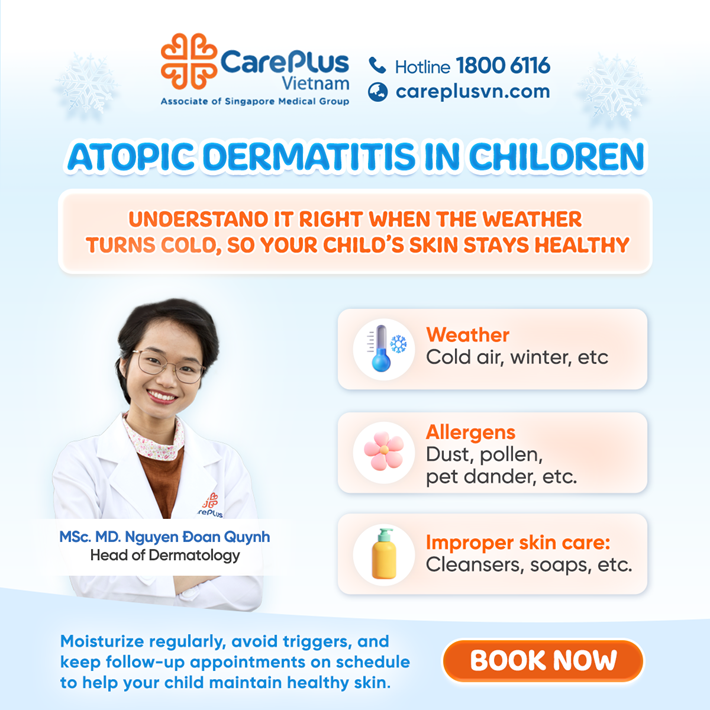
Weather: Dry air makes skin drier; the disease is usually worse in winter and better in summer.
-
Allergens: Pollen, house dust, pet dander; certain foods such as beef, eggs, peanuts, shrimp, and crab.
-
Unsuitable skin care: Using unsuitable soaps or cleansers, or poor hygiene.
5. Complications to be aware of
Atopic dermatitis is not life-threatening, but if not treated promptly and properly, it can cause:
-
Impact on daily life: The baby is fussy and cries, sleeps poorly, refuses food or is a picky eater, which may affect development.
-
Superinfection: Inflamed skin is prone to bacterial, viral, and fungal infections, making the disease worse.
-
Repeated recurrences, which may leave scars and skin damage.
-
Psychological effects: Older children may feel self-conscious and avoid socializing because of teasing or feeling different from their peers.
-
Risk of other allergies: More than half of children with atopic dermatitis may develop asthma and hay fever (allergic rhinitis) by age 13.
6. Treating atopic dermatitis in children
The goals of treatment are to relieve itching, reduce inflammation, keep the skin moisturized, and prevent infection. After an examination, the doctor will give instructions suited to each child.
1. Home care
Parents should follow the doctor’s treatment plan and attend follow-up visits on schedule. In addition, you can consider bathing your baby with gentle herbal leaves such as betel leaf, green tea, or star fruit leaves. These leaves are easy to find and inexpensive, and they help relieve itching and provide supportive anti-inflammatory effects.
Note: Choose naturally grown leaves free of pesticides, wash them thoroughly, and use them consistently. This is only a supportive measure and must be combined with the medications and creams prescribed by the doctor.
2. Medication as prescribed
Medication is chosen based on the stage and severity of the disease, the affected skin area, and the baby’s age. Treatment has two phases:
Intensive (attack) treatment
-
Use topical corticosteroids of an appropriate potency, at a sufficient dose, for a short period, and taper gradually to avoid relapse.
-
Mild cases may not need them.
Maintenance treatment (only for severe or frequently recurring disease)
-
Use topical Tacrolimus or Pimecrolimus when signs of relapse appear.
-
Use topical corticosteroids intermittently.
Side effects of corticosteroids to be aware of:
-
Skin atrophy (thinning)
-
Para-Cushing syndrome
-
The risk increases when applied to occluded skin, for example in babies who are tightly wrapped in diapers
When secondary infection occurs (the skin stays red despite proper care and adherence to treatment): bacterial infection requires oral and/or topical antibiotics; viral infection requires oral and/or topical antivirals.
3. Moisturizing: the essential foundation of treatment
Moisturizing is the fundamental treatment at every stage of the disease. Studies show that moisturizers increase the effectiveness of topical corticosteroids, reduce the need for medication in mild and moderate cases, limit side effects, prolong periods of stability, and prevent flare-ups.
Criteria for a good moisturizer:
-
Has published research with clear evidence, especially in children
-
Safe for long-term use, fragrance-free, paraben-free, non-irritating
-
Maintains ideal hydration, with a pH similar to natural skin
-
Has anti-inflammatory and anti-itch activity
Correct usage:
-
Apply at least 2–3 times a day, more often when the skin is dry.
-
Apply after bathing or hand washing to lock in moisture.
-
Avoid the mucous membranes of the eyes, nose, and mouth.
-
During an acute flare-up when using corticosteroids: apply moisturizer first, then the corticosteroid.
A message to parents
Atopic dermatitis is a journey that takes patience, but with regular moisturizing, avoiding irritants, and following the doctor’s guidance, most children will keep the disease well under control and have healthy skin over time.